Middle School ELA Teachers Ask the Word Nerd Anything || September 2026
Welcome to the first-ever Ask Me Anything!
This school year, I’m trying something new inside Word Nerd Collaborative. Each month, members can send me their questions about books, reading, student engagement, lesson planning, or whatever else is keeping their teacher brains busy. I’ll choose a few to answer and share my ideas, strategies, and resources.
For our first round, I’m tackling three VERY different questions: a First Chapter Friday hack, book recommendations for habitual non-finishers, and what to do when your students are significantly below grade level. (If you’d prefer to watch a video version, click here.)
Let’s get into it!
QUESTION #1: Do you have a First Chapter Friday recommendation for September 11th?
Dana, a teacher in Pennsylvania, reached out looking for a First Chapter Friday video she could use in connection with September 11th. I didn’t have one. But I did have a hack!
I suggested I Survived the Attacks of September 11, 2001: The Graphic Novel by Lauren Tarshis. Of course, most teachers aren’t going to have 25 copies of a graphic novel sitting in their classrooms. And graphic novels can be particularly difficult to read aloud because so much of the storytelling happens through the illustrations.
Here’s the trick: use the book preview available through online booksellers.
For example, search for the book on Amazon and look for the “Read Sample” option. Many books allow you to preview the first several pages — which is exactly what we need for First Chapter Friday!
Project the sample onto your classroom screen and scroll through the pages as you read aloud. Now students can hear the story AND see the illustrations, panels, text placement, and other visual elements.
This works particularly well with graphic novels and novels in verse, where the way the words and images appear on the page is an important part of the reading experience.
You can also use this trick anytime you want to share a book that I haven’t featured in my First Chapter Friday video library — or when you simply want to do the reading yourself.
One tiny online button = a whole lot more books you can share with students.
QUESTION #2: What books would you recommend for habitual non-finishers?
Amanda, a librarian in Virginia, asked for three book recommendations for those students who are constantly starting books…but rarely finishing them.
Instead of immediately thinking about three specific titles, I started thinking about what kinds of books make a habitual non-finisher more likely to keep reading.
I landed on three strategies.
1. Match an accessible format with something they already love.
If a student would rather be gaming than reading, why fight that interest? Use it!
Gamerville by Johnnie Christmas is a graphic novel centered around video games and competition. The graphic format makes the reading feel accessible, while the subject matter gives a gamer a reason to pick it up in the first place.
Another example is Dragon Hoops by Gene Luen Yang. It's a graphic novel about a championship basketball run that also weaves in fascinating basketball history.
Both books also have something else going for them: competition. There's a built-in reason to finish. Who wins?! And this is where your relationship with a reluctant reader can help. Check in with them.
“Did you find out who won yet?”
“I NEED to know what happens.”
“You have to come through for me on this one!”
Sometimes knowing that someone else is waiting to hear about the ending is just enough motivation to keep going.
2. Give them a book that creates a NEED to know.
Survival stories are great for this.
Lifeboat 12 by Susan Hood is a novel in verse based on the true story of children evacuating England during World War II whose ship is attacked. The verse format makes it a faster read, while the survival storyline keeps pulling readers forward.
Do they make it?!
Beneath by Roland Smith offers a similar pull. The story involves a dangerous underground society beneath New York City and a boy trying to find and save his brother. An added bonus? The chapters are incredibly short.
For a student who struggles to finish books, “one more chapter” feels much more doable when that chapter is only a few pages long. Small wins add up.
3. Get them hooked on a series.
Once a habitual non-finisher actually FINISHES a book, I don't want to immediately hand them another big decision.
“What should I read next?”
Nope. Let's make this easy.
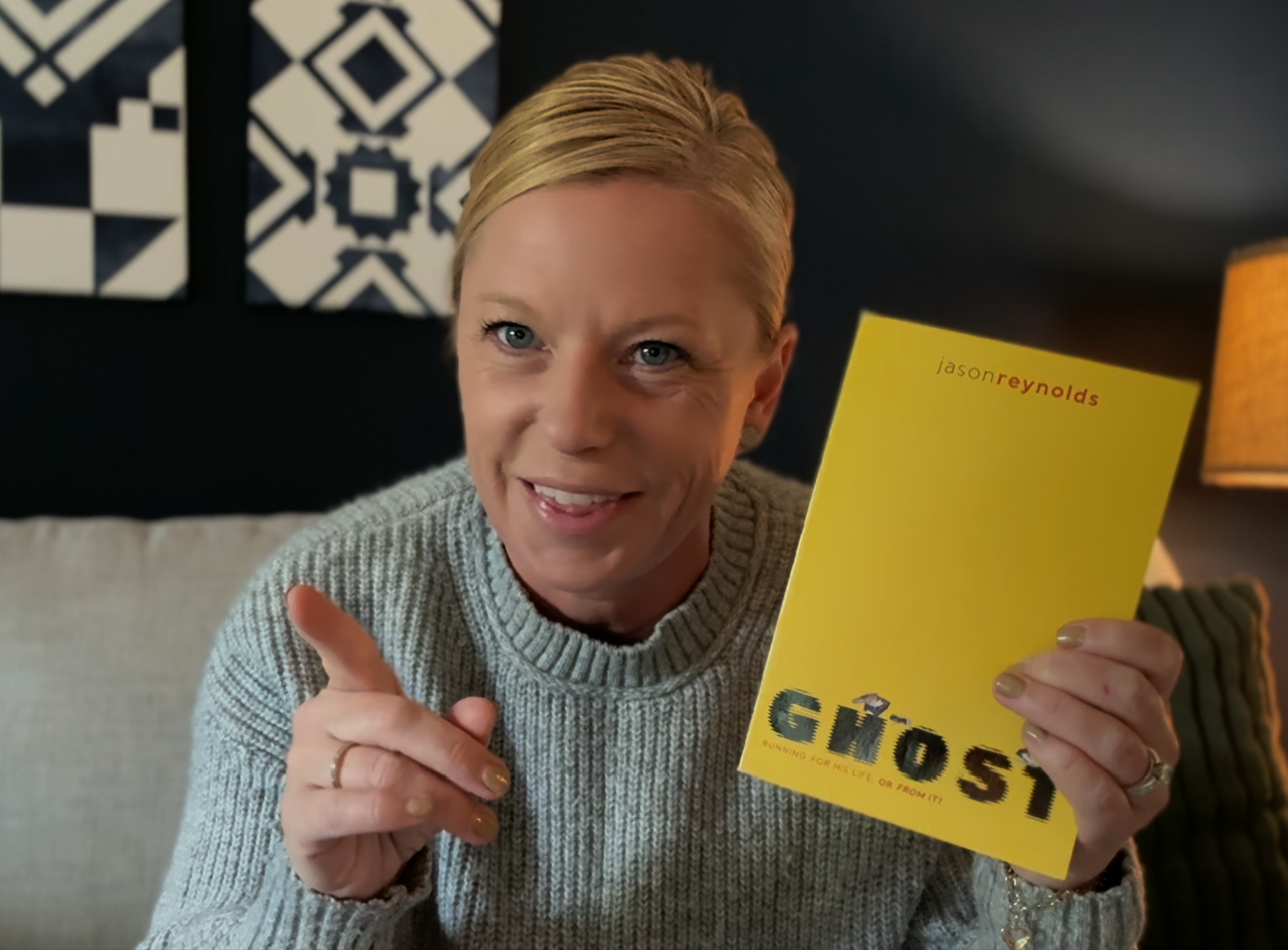
That's one reason I love Ghost by Jason Reynolds. It's short, fast-paced (pun absolutely intended!), and filled with memorable, relatable characters. Even better, it's the first book in the Track series.
Finish Ghost? Great. The next book is ready and waiting.
Series reduce the decision fatigue between books and allow students to carry their momentum forward.
The I Survived books are another fantastic option, whether students choose the traditional prose or graphic novel editions. The Who Was?, What Was?, and Where Is? books can work the same way. They're accessible, quick, and there are SO many topics to choose from.
For habitual non-finishers, I wouldn't focus only on finding “the perfect book.” I'd look for books that offer accessible formats, high-interest topics, suspense, short chapters, and an easy path to whatever comes next.
The goal is to help them experience that feeling of finishing a book — and then help them do it again.
QUESTION #3: HELP! My students are so far below grade level. What do I do?
This question came from Mindy in Florida, and I know she's far from the only teacher feeling this way.
When the gap between where students are and where they're “supposed” to be feels enormous, looking at the whole thing at once can be completely overwhelming.
Instead, think about a game of Chutes and Ladders. You're standing on square one, looking all the way up at square 100. Of course we'd love to land on a magical ladder and shoot halfway up the board. But most of the time, that's not how progress happens.
We roll the dice. Move a few spaces. Roll again. Move a few more. Progress happens one square at a time.
Recently, my son mowed a neighbor's lawn for her. He walked the mower over, mowed the entire lawn by himself, and came home. One task, right? Not even close.
That moment was actually about three YEARS in the making.
My husband didn't teach him everything about mowing a lawn in one afternoon. He started by mowing the trickier front yard himself and then handed the mower over in the flat, easy backyard. Once that felt manageable, they added more. Then more.
Eventually, my son learned how to start the mower, fill it with gas, mow the entire yard, safely transport it to someone else's house, and do the whole job independently. There were dozens of tiny skills hiding inside that one seemingly simple task.
Our struggling students need us to do the same thing.
Take the skill you're trying to teach and break it into the smallest possible pieces. But here's the important part: You don't necessarily have to start with the first step. Start with the easiest step.
Give students an early opportunity to succeed.
Look. You did it. You've got this. Now let's add one more piece.
Once they've built confidence and momentum, you can layer in the harder skills while continuing to walk alongside them, offer feedback, and provide support.
And if square one to square 100 still feels painfully far away? Make the progress visible.
Create a game board. Fill a thermometer. Make a countdown. Add checkpoints. Let students SEE that even though they haven't reached the ultimate destination yet, they're moving. Gamification doesn't have to mean turning every lesson into an elaborate game. Sometimes it simply means making progress tangible.
And if you're struggling to figure out what those bite-sized steps should be, this is also a great place to use AI as a planning partner. Inside my free Word Nerd Daily app, RitaBot is programmed around the kinds of lesson-planning strategies, engagement ideas, and teaching approaches I've used over the years.
Try giving RitaBot the skill you're teaching, the age or grade of your students, and where they're struggling. Then ask: “How could I break this skill into smaller, manageable steps for students who are currently below grade level?”
Keep going back and forth until you have a progression that feels doable for YOUR kids. Because you don't have to magically leap from square one to square 100. You just need to figure out the next square.
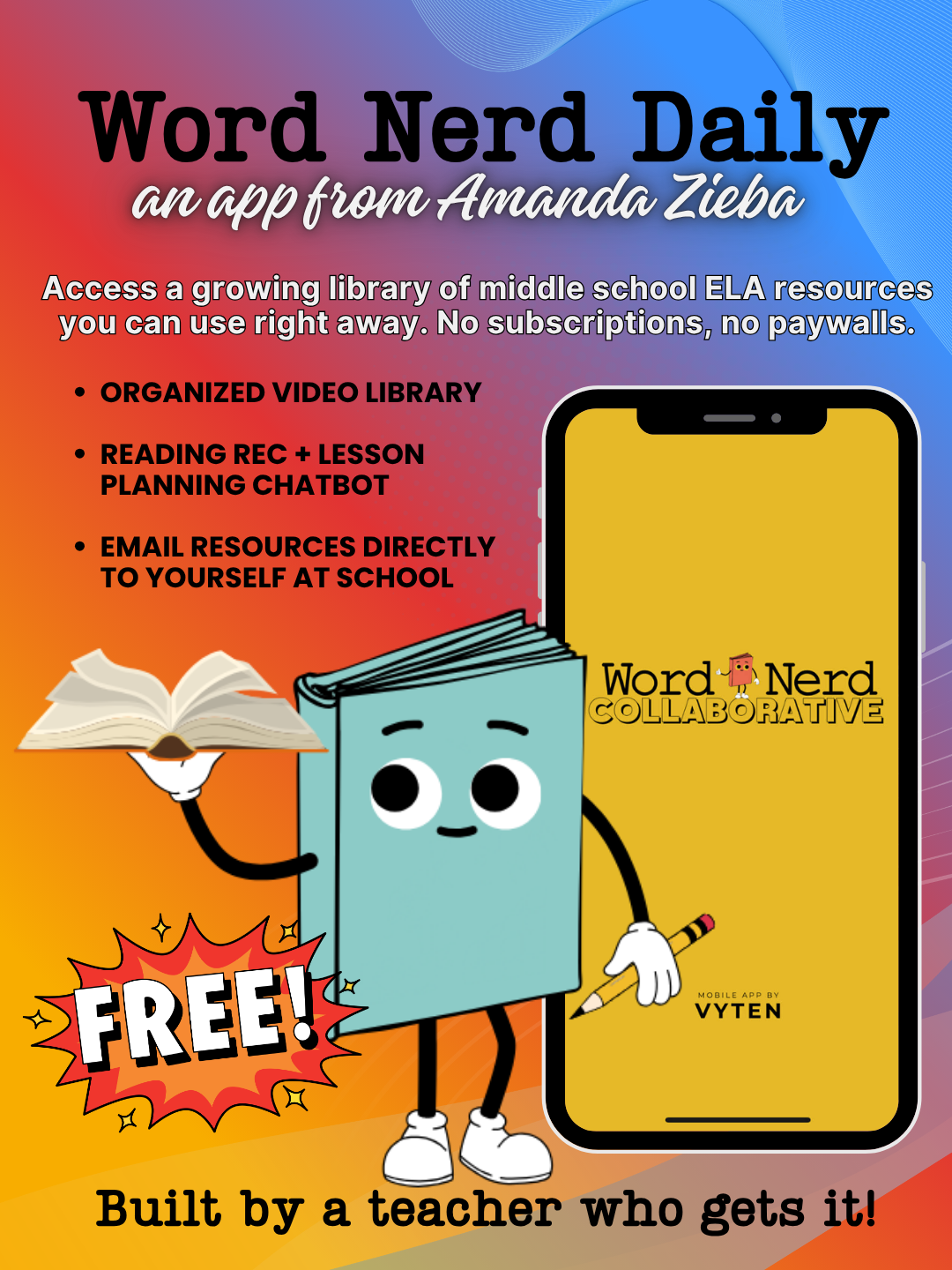
Download WORD NERD DAILY. Inside the free app, you’ll find:
First Chapter Friday videos
Writing prompts
Teaching tips
Brain breaks
Book recommendations
RitaBot to help you plan fast
Available in the App and Google Play Store
Have a Question for the Next Ask Me Anything?
That's a wrap on our first Ask Me Anything! If you've got a middle school ELA question rattling around in your brain — books, reading engagement, writing, lesson planning, classroom strategies, or anything else — I'd love to hear it.
Members of Word Nerd Collaborative can submit questions for future Ask Me Anything editions, and yours might be the one I tackle next!
Until then, keep taking it one book, one strategy, one student — and sometimes one tiny square — at a time.
Happy teaching, my friends!
~ Amanda